

Most of us have grown up with the festive fairy tale. The jolly man with the white bearded and red-suit, steering Rudolph and company across the night sky and landing in his present-laden sleigh on the rooftop of every good, or not so good, child in the land.
It’s pure magical and imaginative bliss, and not just for children – no parent would be alone if they still secretly wished that it was all true and they could go back to that simplistic sense of wonder and innocence again, would they?
It’s also unavoidable considering how much effort goes into keeping the story alive. Story books, television shows and adverts, shops, outings, school and of course parents themselves, all feed the myth. Come early November and you don’t even need to venture away from the front door to find yourself getting swept up in it all.
But when is the right time to tell your child that the man himself doesn’t actually exist, without shattering their little imaginations, not to mention their trust into complete smithereens, for eons to come?
It’s a hotly debated topic between those who are utterly convinced that any form of ‘lying’, albeit well intended, is the worst parenting crime ever to those who see no harm in bringing about a little festive creativity in order to make it all as magical as it could possibly be.
Well, the answer is that quite simply there is no ‘right’ age to deliver the truth. There is no ‘right’ age because it is wholly dependent on your individual child, his or her personality, the circumstances in which he or she asks and your particular family beliefs and values.
If you’ve gone for the whole Santa creation, bells and all – pardon the pun – and you’ve kept that going since they were old enough to listen and buy into it, then you could be in for some very tough questioning! However, let’s be brutally honest here and ask ourselves how many of us know someone who was permanently and psychologically damaged, or plagued with parental trust issues, by finding out the truth about the man in red?
All children reach an age when they are perfectly able to tell the difference between a very serious and potentially damaging lie and some well-intended festive magic, don’t they? Yes, your child may be angry with you at the time he or she finds out – it’s a human emotion all children go through – but you might want to ask yourselves “did the magic it brought for as long as it did outweigh the so-called ‘lying’”.
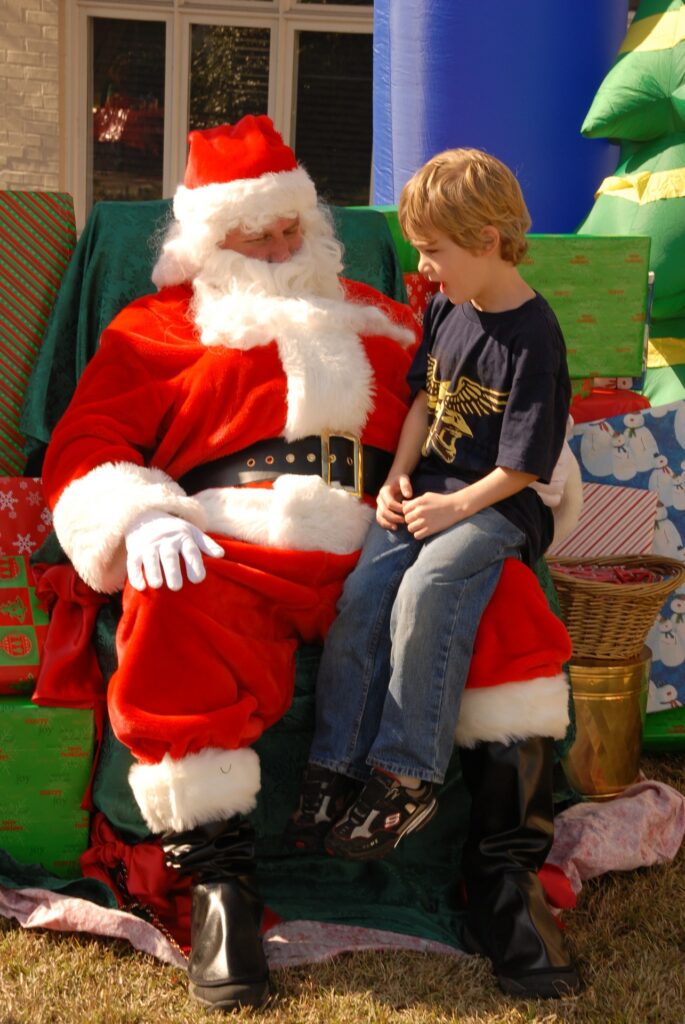
It’s also worth remembering that the ‘dreaded’ day they learn the truth isn’t always a huge incident or earth shattering realisation. Many children come to an age when they naturally accept that, as nice as it was to believe, it was just a story that made them very happy for a few years – they might just thank you of all those wonderful memories they have stored up. The doubts have crept in gradually, especially when you’ve slipped up here and there – “Santa has wrapped my present in exactly the same paper as the roll I saw at the back of Mum and Dad’s wardrobe…” Or the ‘Santa’ at the local shopping center seems mighty short compared to the tall broad shouldered Santa they met last year… They might not openly acknowledge such details, but on a subconscious level it all goes in until eventually the evidence just doesn’t add up and the truth dawns on them – a kind of slow and less harsh awakening, one might say.
For other parents and children it doesn’t work quite so smoothly. Perhaps someone in the playground announces that Santa can’t be real because he stayed awake and caught his Dad sneaking in the room with a crammed stocking. Or your child gets teased or laughed at because they believe in Santa but some, or even most, of their peers don’t. If this is the case then it might just be kinder to tell them the truth as gently as possible – especially if your child has asked you outright and you don’t want lie directly. But, again, it’s more about knowing your child well enough to understand what he or she needs to hear and what will work best at the time, or in the long run.
Some parents use the opportunity to come clean when the question of why some children receive copious amounts of presents and others don’t comes about – arguably, a question that needs answering far more urgently than the ‘is Santa real or not’ one. Why did Santa give him so much and me far less? Have I been bad? Questions that would tug at the heart of many a parent but, again, explaining why that is will really be down to your particular beliefs and circumstances. However, if you do choose this time to reveal the truth then your child will at least feel he’s no less worthy than his friends.
The truth of the matter is, whether you think feeding the myth is naughty or nice it ultimately comes down to your child’s individual needs and beliefs, as well as circumstances, rather than anyone else’s.