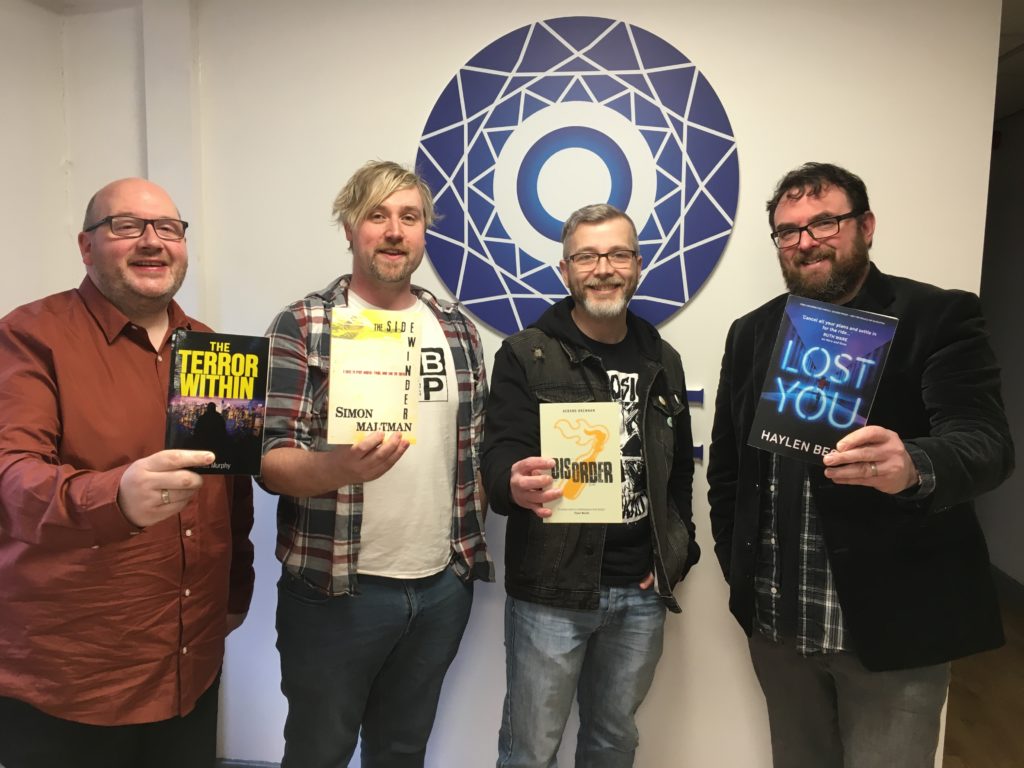
As part of the 2019 Northern Ireland Festival of Writing four crime writers from across the country joined the Noir Share writers panel at The Raise, Belfast.
We caught up with crime fiction writers Stuart Neville (Lost You), James Murphy (The Terror Within), Gerard Brennan (Disturbed) & Simon Maltman (The Side Winder) to chat about the crime fiction industry in Northern Ireland and their career.
To find out what else is happening during the festival go to festivalofwriting.org
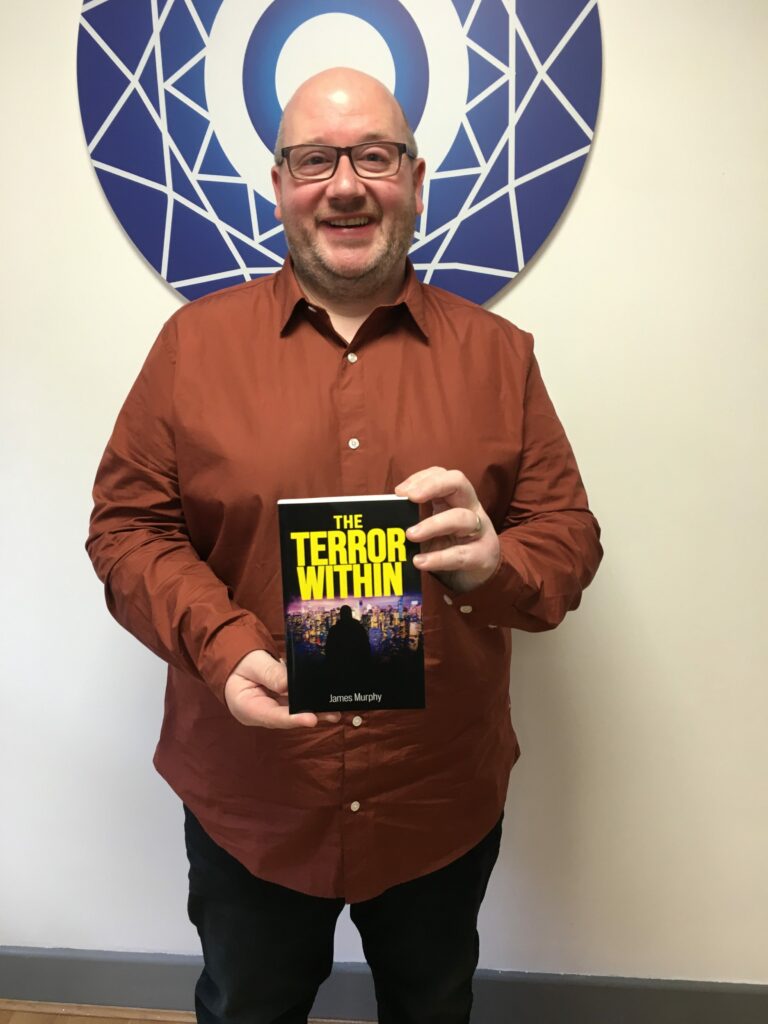
James Murphy, author of The Terror Within
Tina: Hi, James. So, tell us a little bit about The Terror Within, and where it came from.
James: Well, The Terror Within is the sequel to my first published novel, which was called The Rise of Terror. I suppose, without giving away too many spoilers, it ended with a lot of what we thought were issues that were resolved within the story. But it transpired, maybe right towards the end, that none of them actually were.
James: So, this was the vehicle to take the story forward.
Tina: And whereabouts are you in your publishing career? This is your second book, I believe?
James: It’s my second book. So, I would probably say I’m pretty early on in my publishing career. Learned a lot along the way. So, probably would consider myself as an emerging writer, at the moment. As opposed to still being a newbie. But still a lot to learn and a long way to go yet.
Tina: What would you say has been the most challenging part of becoming an author?
James: Overcoming your own lack of confidence in yourself. It’s okay to know that you have an idea and you would like that idea to work but if you want books to sell, then you want to make that idea something that other people will be interested in. Your biggest enemy is yourself and you have to, kind of, deal with yourself first.
Tina: And tonight you hosted the Noir Share panel. How did it go, and how do you feel?
James: Yeah. I was really nervous about it. I speak to people for a living, every day. But when you put it in a different context, it’s horrendous. I don’t do it naturally. I think my wife would be the first person to attest to that. But, it was such a buzz. It was great.
I really enjoyed the event. I really enjoyed the chat. But the thing that was really the biggest thing for me tonight was actually hearing some of the feedback. Because the purpose of our event was to actually encourage people to sit down and start writing. Particularly within the genre. And I think we’ve done exactly that.
Tina: When it comes to, so you say yourself, you’ve been through the newbie writer thing. You’re now an emerging writer. What would your big tips be to someone who’s maybe sitting in their bedroom or whatever, they’ve got something written or maybe they’ve just got an idea, what’s your advice?
James: First of all, think about what you want to do with it, yourself. In terms of, do you want to take it further and why you want to take it further. Hone it, a little bit. Because it’s okay having an idea. You know, when you look over your work, there’s always time for editing, there’s always time for improvement. So, shape it until it’s something you’re happy with.
And then, I think the important thing is to have the confidence to send it out into the world. Now that doesn’t necessarily mean going publishing, or self-publishing straight away. It means maybe giving it to some people who will give you some honest feedback. So, not your family, not your mates. You know, put it out in maybe writing groups and so on. Who can give you some honest feedback.
Tina: What, for you, has been the biggest highlight of your writing career so far?
James: I think actually holding the book in your hand. You know, I’ve done this, I’ve achieved something. Has been a big thing for me. And that has happened with both the books, I have to say. I think that’s something that’s never really going to go away. You’ll always get that. But I think a really big highlight has actually been tonight. Because, to me, it kind of has given me recognition not from other people, but more so myself, that yeah, I’m a writer, this is what I do now.
James: You know, I can do the job and all that’s involved in it.
Tina: And do you remember that point at which you accepted that you were an author?
James: No. Sometimes I probably still haven’t accepted that I’m an author. I think when it becomes more and more the day job, rather than the stuff that you really have to fit in around the day job … You’ll always have to make sacrifices. But, you know, when you’re having to give up your family time and time with young ones and so forth, then, you know, that’s an issue. But, I think if I can say, “Yeah, it’s the day job now.” Then I’ve arrived.
Tina: And very lastly, what’s next for James Murphy, the author?
James: James Murphy, the author, has the final Terror book to write. So, this is part of a trilogy. This is the second book in the trilogy. So, I’m looking at developing the outline for the story at the moment. I’m actually going to take a break for a wee while because this has been quite intense in terms of the writing process and the promoting process.
So, I’m going to take a break from it for a while, and then get back into writing the final Terror book. But I also, and Tina you would know this, I’m very actively involved in the Northern Ireland Festival of Writing and the Merlin Project. That, I think, is going places. It has very definitely proven that it’s going places. So, I think that’s going to take up a fair bit of time and I’m very happy to say that’s the case.
Tina: And you totally stole my last question. Which was, what was it about the Merlin Project and the Festival of Writing that got you involved?
James: Well, obviously, it actually came from a conversation with you. Because you had talked about the Merlin Project and your ideas.
And I thought, you know, we’re coming from different backgrounds and actually we still have this same idea. You know, you were coming from a journalistic publishing background, and I come from an education background. And we both see that there’s a need for the type of work that the Merlin Project is set up for. And what the Northern Ireland Festival of Writing is hoping to achieve. So, I’d hark back to the success of the festival. I mean, it’s our inaugural one but the events, so far, have been fantastic and the feedback has been great. So, if this is the success of the first one, then long may it continue.
The Terror Within by James Murphy is available now from Excalibur Press. It will be available on Amazon from April 18th, 2019
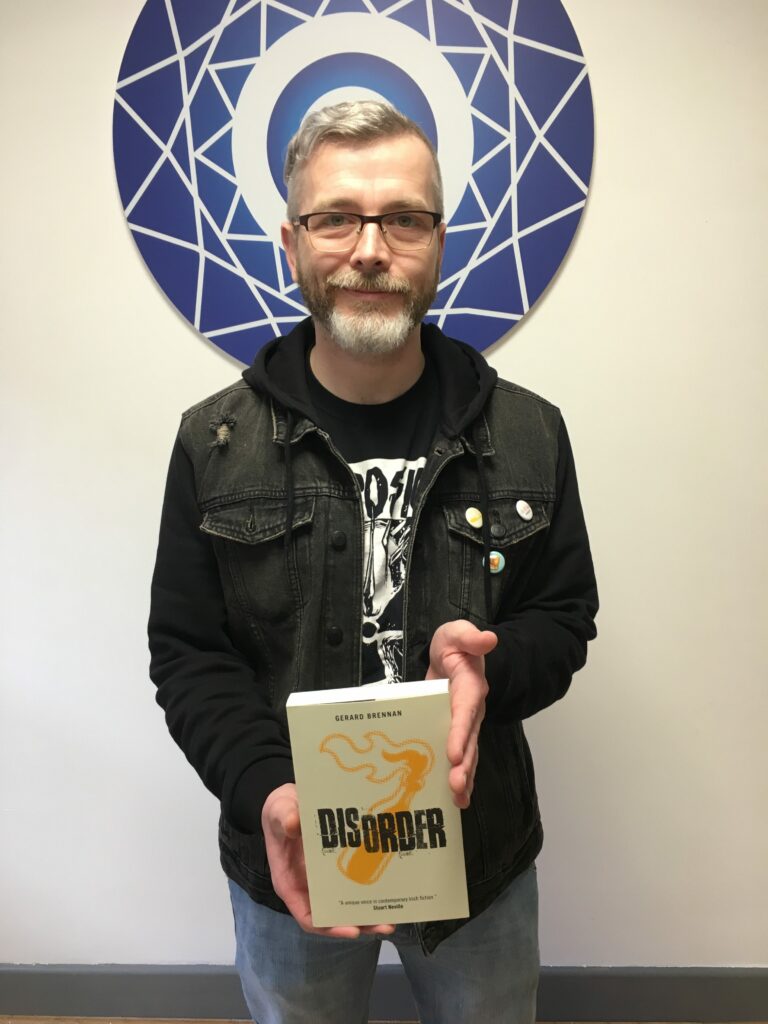
Gerard Brennan, author of Disturbed
Tina: Tell us a little bit about your latest book and how the idea came around.
Gerard: The title of the book is disorder published by No Alibis Press. It’s basically a book about recreational rioting that goes on in Northern Ireland, or mostly Belfast. But in other places as well. I happen to set in Belfast to contract to concentrate that one idea.
It was published by No Alibis Press, which is an extension of No Alibis Bookshop on Botanic Avenue. The reason that they were able to read the book was because it made up part of my PHD in Creative Writing. I asked … they have a binding service and I asked them to bind it for me. And David had a read of it and when he had the idea of having a publishing company, he asked me was it still available. And I’d been spending so much time in that shop and met so many writers from there, I thought it was the perfect place for it to come out of and I love the job that he did with it.
Tina: Tell us a little bit about this story and how it all unfolds.
Gerard: Sure. It starts off … it’s a very fast paced book. It starts off in the middle of a riot and the central characters all encounter each other at this riot. And from there, you get to learn about Detective Bridge, who basically holds the book together. And is a not very nice police offer. But hopefully you find a sympathy for him and understand some of his actions, even though they are pretty gritty.
Tina: And whereabouts are you in your author journey, as such?
Gerard: Knackered. I have published a few books through different small presses and this is the culmination, so far. I have sort of an academic background, I suppose you would say. Because I’ve done a masters and a PHD in Creative Writing. But I was recently talking to an agent and he had likened my whole background to doing an apprenticeship in writing. Which I think is a very fair point. Most writers are, most who are seen as an overnight success, they’re actually ten years writing before they become an overnight success. I’ve been writing around ten, so at this stage I’m due to be an overnight success.
Tina: Yeah. And what would you say is the most challenging thing about being an author?
Gerard: Getting people to take you seriously. They think that is kind of a fun … a bit of crack and that there’s that whole stereotype about the drunk Irish writer, which sometimes I play on too, for the fun of it. But really, I’m kinda boring. And there’s also … what was the question again?
Tina: What has been the most challenging?
Gerard: Oh, remembering questions. Most challenging part is trying to get people to take you seriously for doing something that you want to do anyway. And also getting noticed, as a writer.
Tina: What for you has been, I suppose, the highlight of the career? That sort of high point?
Gerard: This is the thing about writing. It delivers highpoint all the time. Do you know? I can answer this question differently every time I think about it. My latest highest point was receiving my author copies of this book. But there were others along the way. Getting to travel with Arts Council funding. Having the privilege of doing a PHD with Dell funding. Both of which are getting cut at the minute, and I wish people would stop cutting these arts so that other people have a chance to do the things that I’ve been lucky enough to do.
Other highlights include making friends with some of my favourite writers. Attending festivals. Having that sort of writer lifestyle that you kind of imagined but also knowing that you can go home every night to your comfortably seat and the writing be sitting there, waiting for ya.
Tina: Yeah, and what would be your advice to up and coming writers?
Gerard: Writing is a waiting game. Do you know? So I would say that you need to be patient. I think that’s something that is lacking, quite a lot, these days. People expect things to happen much quick … much more quickly. And it does seem to be the case in a lot of different endeavours, and whether it be stand up comedy, acting or whatever. Some people will break through quickly and some people won’t, but if it’s something that you really wanna do, have the confidence to be patient and wait ’til it’s your moment.
Tina: And when it comes to the writer’s community, there’s a lot of discussion about the importance of having that community around ya. At what point did you find the community, in your writing journey? Was it late on, or was it early on?
Gerard: No, it was actually quite early. One of the ways that I started to meet people was through a blog called Crime Scene Northern Ireland, which I ran for … it was 2007, I think, I might have started. And I hadn’t published anything at that stage, other than maybe a few short stories. But I was interested in all the stuff that was going on here, hence the name Crime Scene N Ire, as I joking called it CSNI. But it was … when blogs weren’t as popular and there wasn’t as much social media and stuff like that, so I was an unusual thing to have. And like newspapers did articles on this blog, and I was like I’m just writing stuff on the internet, you know? And I got interviewed by the BBC Radio. Different things. I became sort of known as somebody who knows a lot about crime fiction. Do you know? Then I thought, suppose you better write some, you know.
But that did introduce me to all the different writers and introduced me even to No Alibis book publishers and promoters were sending me free copies of books to review and trying to get me to interview their authors and stuff. And just through that, you sort of made connections, which eventually became friendships.
Tina: And how hard is it, aside from the writing part of being an author, how had is the other side? The promotion, getting it out there, the pitching it takes, the publishers and their agents and all of that?
Gerard: Yeah, it’s surprisingly tiring. But then, if you think about it, getting out and about, if you’re … a lot of this stuff looks like fun. And I like to make the most of anything I’m doing, ’cause I don’t get out of the house an awful lot. When I do go out, I try my best to have fun.
You sometimes forget that you need to stop doing that and take a break from it. It’s being where you need your energy and that you need to sleep. When I worked full time and hadn’t published anything, I use use to just sacrifice my sleep to write. And that worked up until a point. But I noticed my health was slipping away. Now that I’m a little bit older and way grayer, I’ve learned that you do need to take these breaks. Even though it feels like fun, you can still burn yourself out.
Tina: Very lastly: what’s next for you?
Gerard: Keep on writing, that’s all you can do. Every book has to be the best book that you can possibly write and I’m currently working on the best book I’ve ever written.
Disorder by Gerard Brennan is now available from Amazon
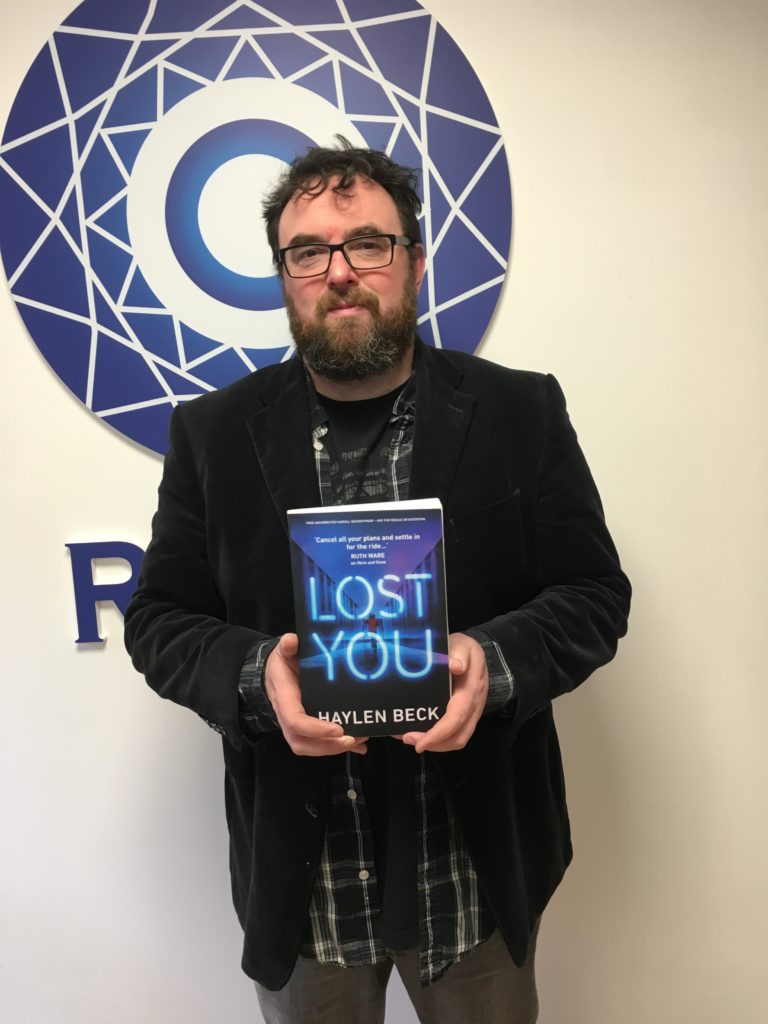
Stuart Neville, author of Lost You
Tina: Tell us a little bit about the latest book and how it came around.
Stuart: Well, first of all I should point out it’s written under my alter ego, of Haylen Beck. The books with Stuart Neville tend to be set in Northern Ireland, usually, the books as Haylen Beck are usually set in the States. So, this one was set in the States.
I was inspired initially by something that happened when I was on holiday with my family. We’re in a typical, sort of Spanish resort sort of thing and our little boy, who was three at the time, or three and a half, developed this habit of going out in the corridor if he saw an open lift, open elevator, he would charge for it and start hitting buttons. So I was always the one who was sprinting after him, trying to catch him before he got too far, because the thing that terrified us was that if he managed to … if the lift doors closed and the lift moved, how would we know where he went up?
And so that sort of stuck in my head, and for a while, it was a couple of years later this book then took shape. The way it developed was that incident of the boy disappearing in the elevator. In the book, the lift doors close and the mother doesn’t know where the little boy went up. But, that is really a springboard for a bunch of other stuff that then goes on, there are other people around who might have interest in the child, that sort of thing. But, it’s unfortunately one of those books I can’t say an awful lot about, because it would give too much away.
Tina: And, how long have you been writing now?
Stuart: My first book was published in 2009, so ten years ago, I’d written two novels before that, that will never see the light of day.
Tina: Will it ever see the light of day, do you think? No? That’s it. It’s gone, it’s in the bin?
Stuart: No, I dug one of them out a few years back and had a read of it and thought, wondered, is it salvageable, can I re-write this and knock it into shape. But no. No.
Tina: What attracted you to the crime genre?
Stuart: I think those writers are popular reading. That’s what I read. Then my first novel, debut novel had a bit of the supernatural in there, as well, and that would reflect that the first grown up author I read as a kid was Stephen King. You know I grew up through the 80s, with Stephen King. As an adult it was people like James Elroy and Denis Lehane, particularly the Americans, certainly were more authors that I’ve started to get into. So, that influenced what I was writing and pretty much, even if sat down to try and write a horror story, the horror story would end up being a thriller. Just that … you can’t help writing what you write.
As I said, it’s a part of what you’ve read, what it means, what you’ve taken and absorbed you.
Tina: What would you say has been the hardest part of being an author over the years?
Stuart: I’ll be honest. It’s come to be the actual writing itself. In the previous interview with James there, he told me the idea of … I even think the first novel was the easiest. The second’s a bit harder, the third’s harder again. When you get to ten novels-
Tina: Yeah. That’s where it starts getting difficult.
Stuart: Oh, it starts getting difficult long before that, it’s just degrees. Typically, they just get more and more difficult. Part of it is, I guess, that the more ground you’ve covered the less scope you have. The less frame you have. There’s a part of the danger of repeating yourself. You always want to try and find something different to say, but also the corners you pin yourself into in terms, particularly if you’re writing a series. But also reader expectations; If you build up a readership you always want to be mindful of what’s expected of you from the readers, as well as your editors and agents and so on.
Stuart: So all those different factors, plus the pressure of writing under contract, I find much more difficult than just writing on spec. All those different pressures come to bear and I find it a little bit, gets it more difficult. But it’s just a matter of grinding it out.
Tina: Do you remember that moment at which, inside your brain, you were like, “I’m an author now.”
Stuart: Um, there are a few different moments. One moment was … the man that became my literary agent, when he first contacted me. I’d started doing an online crime magazine and an agent in New York happened to read it and contacted me. I remember that being a very, very big moment, and going back and forth with him and working on the book, and so on. Yeah. Being able to sort of say, properly, “I’ve now got a literary agent.” Like, that was the moment where … actually I’d been writing in secret. I hadn’t told anybody I was doing it.
Which is surprisingly common; Quite a few authors do that. I hadn’t told anyone, I thought it was a ridiculous thing to be doing. It seemed like such a nonsense waste of time that we spend hours every night, writing stories. With no hope of it ever seeing the light of day. Then when I actually got a literary agent, I actually started telling people, “Did you know I write? This is the thing I do.”
So that was a big moment, just the validation of getting a literary agent, then another was walking past [Nation’s 00:05:33], the first time walking past Nations, and looked in the window at my book. Been up on the shelf.
Tina: I wouldn’t be able to contain myself. What was your reaction?
Stuart: I sort of walked past a couple of times, then went and asked them if I could sign them. And then there was … I probably went very, very red when I asked them. Another big thing was also the first time I went to a crime convention, crime collection convention, expecting to be given a very short thrift from everybody who was there, but being welcomed in to this kind of reigning community. And that was a big deal, being welcomed by other writers into this kind of … I don’t want to use the word club, because it makes it sound cliquey, and it’s not cliquey, but finding that the … you might imagine there are barriers or walls to keep outsiders out, if you know what I mean? But the fact that I find it such a welcoming community I think was a big moment as well.
Tina: And very lastly, what would be your advice to up and coming authors or people who have an idea in their head and haven’t done anything with it?
Stuart: This sounds terribly glib, but it is just to write. There is no replacement for, I guess what people used to call it bum glue. Just like you sit there and get the words down. That’s a lesson I still repeatedly have to learn myself, ten years on. Being published, I still have to convince myself to sit down and just grind the bloody thing out.
A more practical bit of advice we tend to give people … well, first of all, almost all writing advice is farce. That’s the first thing I’ll say. In the words of William Golding, nobody knows anything. Everybody’s winging it. Don’t let them tell you different. Other thing is, once you’ve written you first book, that’s grand, don’t dwell on it. Write a second one. Then write a third one. Then write a fourth one, ’till you … regardless whether you go with self publishing or it goes to traditional publishing, the mistake I see people make most often is they write one book and then they flog it to death instead of moving on and recognising that, very often people’s first or second attempt isn’t the thing that’s going to get people’s attention.
Stuart: You need to understand that, even I’ve written to date, now, it’s going to be three, four novels, complete novels that have been binned, but that’s part of it. You learn. Every time you write a novel, it doesn’t work, you learn, and move on. So, yeah. Move on, I guess, is the short way of putting it.
Tina: And where can people get the book?
Stuart: Anywhere good books are sold, particularly in Belfast, ‘No Alibis’ is always a good choice, sort of a first port of call, and David is always happy to email or … email David, David’s always happy to mail books around the world and can sign copies and so on.
Here and Now by Haylen Beck (Stuart Neville) is available now from Amazon. Lost You will be out in June.
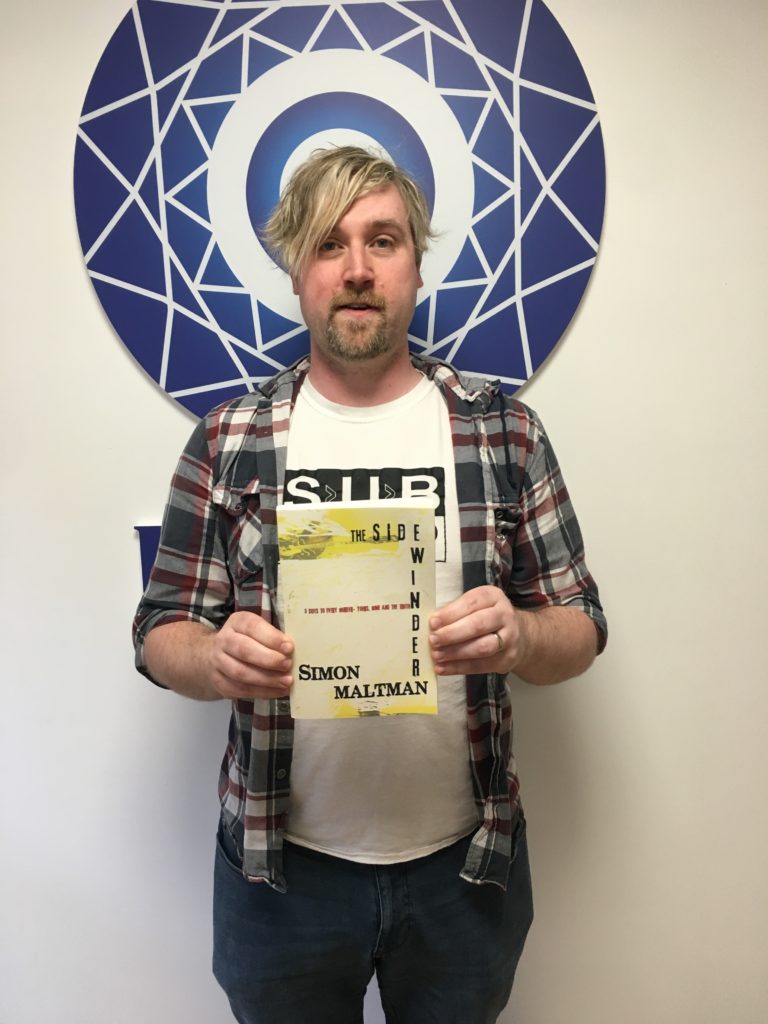
Simon Maltman, author of The Side Winder
Tina: Tell us a little bit about the latest book, then.
Simon: Yes. The latest one is called The Sidewinder. It came out just at the end of the last year. So, it’s my fourth novel. Basically, it follows the story of an early 90s band and in the present day. So they were, sort of, approaching a bit of fame and stardom but didn’t quite make it. In the present day, some of the members are starting to, kind of, turn up dead. There’s a bit of a mystery to it.
Simon: And this story is written from a few different perspectives. Then sort of, leading where the different members are now, doing their different lives. One of them’s still into the music. Another one’s a politician. Another one’s in the police, trying to uncover why all these people are getting knocked off.
Tina: Wow. How long have you been a writer now? Is this your first book, is this in the middle?
Simon: I suppose, sort of, working at the writing as the main creative thing, it’s been about six years. I had my first couple short stories published and my first novel published about three years ago. So, this is the third book. And right at the minute, I’m just finishing off the fourth full-length novel.
Tina: Okay. And what, would you say, has been the hardest part of the journey so far?
Simon: I think it’s been [crosstalk 00:01:20] all the time. I suppose one of the hard parts is, you have to realise there’s going to be lots of rejection at different times. Because you’re never going to get anywhere if you don’t submit a lot and if you’re going to submit a lot, whether it’s short stories or whether it’s trying to sell your book to agents or what not. You’re going to get a lot of rejection. So, really, you just have to be aware that’s going to happen and hopefully, the more good feedback you have and you’ve taken on board [crosstalk 00:01:43].
Tina: And I believe you have come from the music industry into the writing. What was that transition like? Was it easy to do?
Simon: I suppose it was easy, in a way, because I started out doing short stories. So, maybe it was easier to start in to that. I suppose from writing songs and things it was very quick. And my approach as a writer of songs was, sort of, I very much like to write them quite quickly and record quickly. But you certainly can’t do that with novels. I think it’s very much about the ending. I think, from start to finish, a book will take me the guts of a year, really. Whereas you can write a couple songs in a night. So that’s very different.
Tina: What would your big advice be to, sort up, up and coming writers? Or people who want to get in to writing?
Simon: I think, it’s really just to get started. Trying, really working it. Come to events like this and talk to other writers and there’s lots of stuff that you can, you know, get interested in. Lots of groups you can join. I suppose it’s just, again, to be realistic about the rejection, but also be realistic at how your time will be spent, on social media or whether it’s from events and publishers. But I suppose you have to be aware that the act of writing could be a small part of it, but at the same time, it’s something you really need to be doing every day.
Tina: For yourself, who would be the writers that you look up to? Or that you’ve been reading over the years?
Simon: When I first started, my favourites would have been a lot of the American authors. Particularly, the likes of Richard Stark and Raymond Chandler. And now, we’ve got this massive boom of crime fiction in Northern Ireland and I run a walking tour, called Belfast Noir. We’ll want to visit locations of the likes of crime film and TV, but also we’re following different authors and where they place their books and now we’ve got this great community, and there’s just so many good writers from here and through Ireland as a whole.
Tina: And just very lastly, what would you say has been the best part of the journey for you?
Simon: I suppose the best part, really, is that people actually enjoy the stories. Like I was saying on the panel earlier, when you’re writing something you don’t know if anybody will like it or read it. At the minute when I’m editing this current book, you do have those moments when you think, you spent every night for nearly a year and maybe no one will have any interest in this. So, what do you do?
So, I think, whatever you do, you meet people at events that have read your books or you read some reviews online and people enjoy it and that’s the big part, really.
The Sidewinder by Simon Maltman is available now from Amazon
With thanks to the festival sponsors…