- Modest increase in staffing levels
- Renewed fall in business activity
- Selling price inflation at four-month low
The latest Ulster Bank Regional Growth Tracker signalled a modest reduction in Northern Ireland business activity during June, reversing May’s expansion.
New orders also decreased, but companies remained optimistic for the future and raised staffing levels for the first time in five months. Selling price inflation eased despite a further rapid increase in input costs.
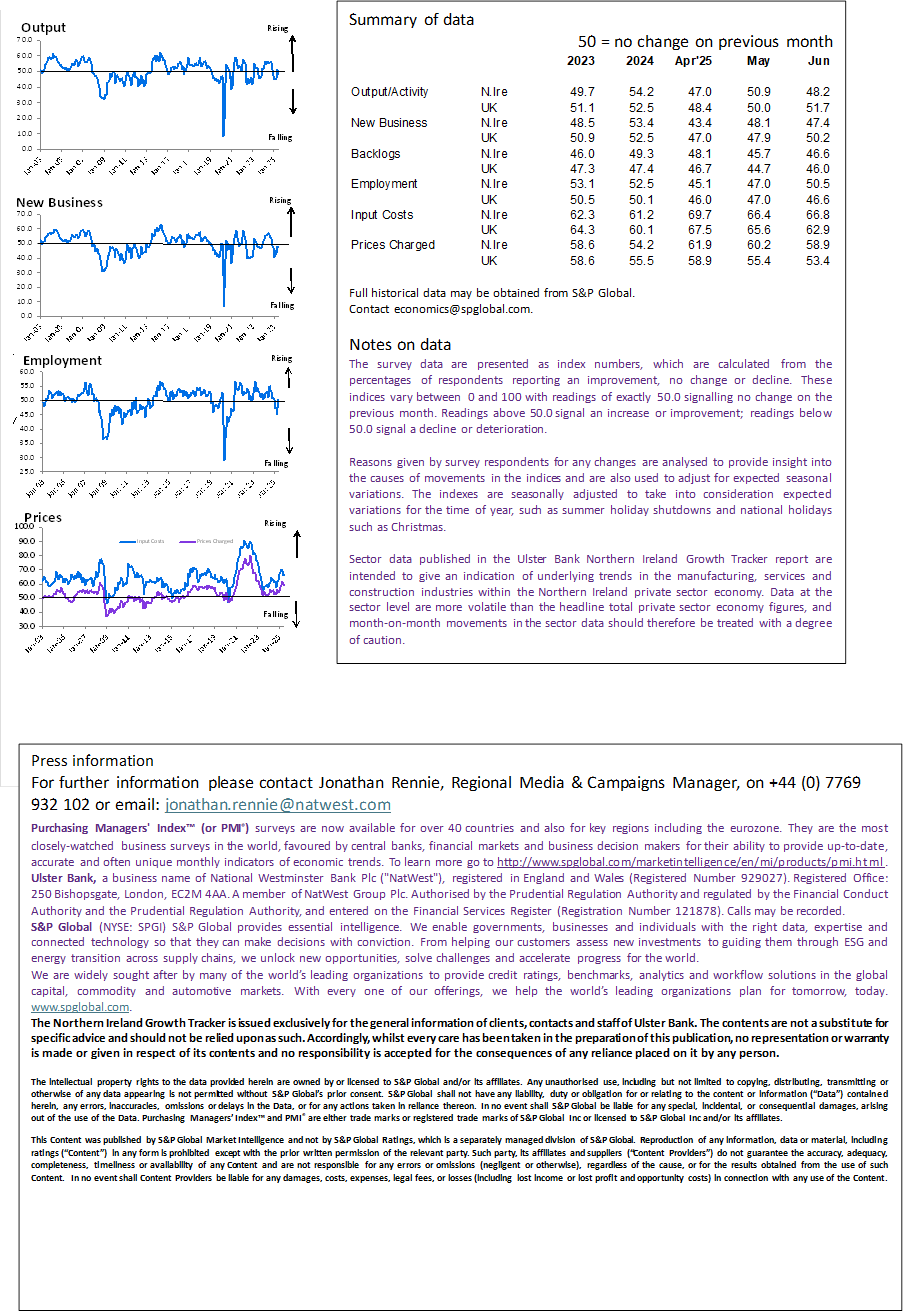
The headline Business Activity Index – a seasonally adjusted index that measures the month-on-month change in the combined output of the region’s private sector – posted 48.2 in June, back below the 50.0 no-change mark following a reading of 50.9 in May. The index pointed to a modest reduction in output at the end of the second quarter.
Panellists mainly linked the fall in output to lower new orders.
Construction was the only monitored sector to buck the wider trend and post an increase in activity. Meanwhile, retail recorded the sharpest decline over the month and both manufacturing and services recorded renewed contractions.
Sebastian Burnside, Chief Economist for Ulster Bank, commented:
“There was good news for the local labour market in June as companies reported an easing of recent recruiting difficulties as they expanded workforce numbers for the first time since January. Moreover, Northern Ireland was the only area of the UK to see employment rise.
“Other aspects of the latest Growth Tracker paint a more subdued picture, however. The expansion in output we saw last month was not sustained into June as new order inflows remained muted. Companies are still confident about the year-ahead outlook, however, so we will hopefully see some demand and output improvements during the second half of the year.
“Although output prices increased sharply on the back of further rapid cost rises, there was a further slowdown in the pace of selling price inflation. If continued, this could potentially help to support demand improvements over the months ahead.”
The main findings of the June survey were as follows:
As has been the case in each month since November 2024, new orders decreased during June. The rate of decline was solid and slightly faster than that seen in May. Respondents indicated a lack of client enquiries and muted footfall. Despite falls in business activity and new orders in June, companies remained optimistic that output will increase over the coming year. The level of business sentiment was broadly unchanged from May and in line with the series average.
Northern Ireland companies increased their staffing levels during June, thereby ending a four-month sequence of reduction. Northern Ireland was the only one of the 12 monitored UK areas to post a rise in employment, although the pace of job creation was only slight. Some respondents indicated that previous difficulties recruiting had eased, enabling them to catch up on filling vacancies.
Employment growth at a time of falling new orders meant that firms were able to deplete their backlogs of work at a solid pace in June. That said, the rate of reduction was slightly softer than in the previous month.
Although Northern Ireland continued to register the fastest rise in output prices of the 12 UK regions and nations, the pace of inflation eased again in June and was the slowest since February. Where charges were raised, panellists generally linked this to higher input costs. Input prices continued to increase rapidly in June, with the pace of inflation ticking higher and remaining above the series average. Around one-third of respondents registered an increase in input costs, again often linked to higher wages and the rise in National Insurance contributions.