
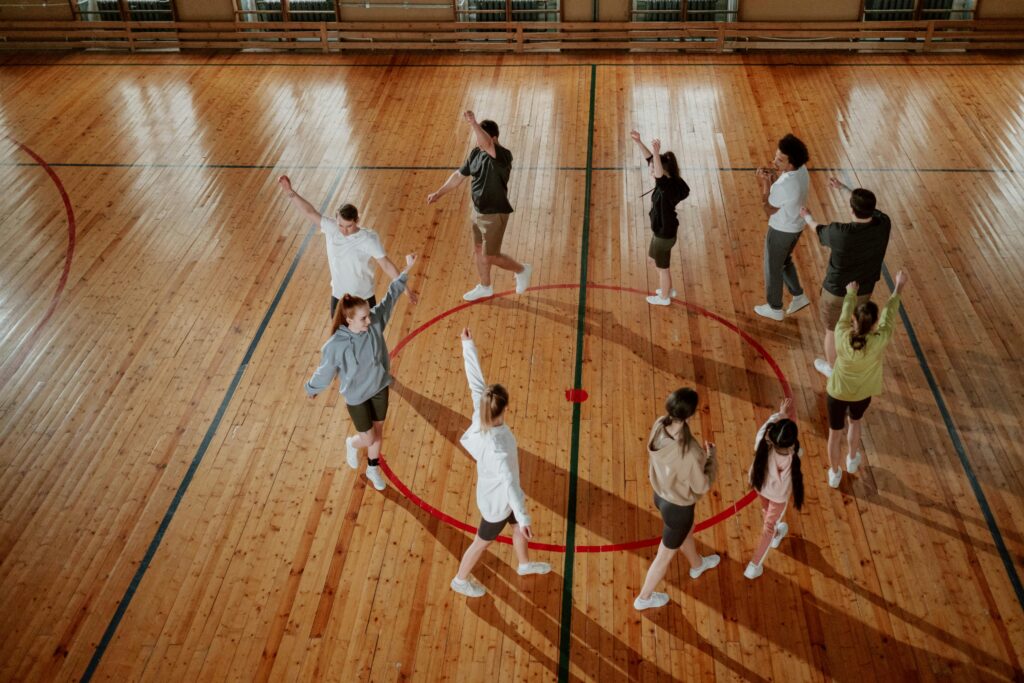
It can definitely be agreed that classrooms are great for teaching the big stuff, like how to solve for x, when Henry VIII lost his head (or made someone else lose theirs), and what happens when vinegar meets baking soda. Oh, and don’t forget all the homework too, that technically teaches kids as well. But not everything worth learning comes with a neat little answer key. Some lessons need a bit more space to move.
Well, literally speaking of course. Just think about PE, while sure, some people don’t have the best memories of PE, thankfully, it’s changed and it’s become friendlier (and more fun) for kids nowadays. Honestly, nowadays PE does a lot for kids than it even gets credit for. But what exactly?
It’s About People, Not the Points
So it’s best to start here, because no, it’s not about winning, it’s not about getting the most points. The best PE isn’t about who’s fastest or who scores the most. It’s about connection. It’s about encouraging your mate when they’re trailing behind, it’s about taking the time to explain a rule instead of snapping. Just generally speaking, it’s about giving someone else a turn, even when you really want to take the shot.
It’s also about making everyone feel like they’ve got something to bring to the table, even if they’re not the sporty type. Again, PE isn’t what it used to be ten, twenty, or even thirty years ago; it’s more about building confidence and sportsmanship nowadays. Plus, it helps that it’s more structured (and less chaotic) thanks to tools like The PE Hub, since this gives teachers the kind of structured support that makes every lesson more than just a run-around.
Teamwork isn’t Just Some Buzzword
It goes back to above; it’s not about winning, but more about having a shared goal. So, you can talk about teamwork until you’re blue in the face, but nothing drives it home like being thrown into a game with three kids who just don’t care or get along with one another. But PE does seem to have a way to push people to just figure out how to pass, how to trust, and how to recover when you all mess it up and lose the match.
You learn who’s a good sport, who’s a bit dramatic, and how to pull things back together. Yeah, it’s messy, it’s real, and it sticks.
Solving Problems
In PE, things go wrong all the time. Well, that’s just putting kids in a room to run around for you. But yeah, who would have thought? Well, that carefully planned tactic is gone in ten seconds flat. Even winning strategies that a team puts together can be ruined quickly. But at the same time, kids figure it out too.
They don’t wait for instructions (granted, sometimes they should). But for the most part, they adjust, experiment, and keep going. So, that ability to think on the fly and make decisions in real time is pretty gold.
There’s the Emotions
Who hasn’t been on the verge of tears in PE? Okay, sure, it’s kids, but still. There’s magic in P.E., but it gives kids the chance to feel things and figure out how to handle it all. It’s where they learn how to lose without sulking forever, how to keep going when things don’t go their way, and how to stay cool when their patience is running thin.